FAQ · REAL QUESTIONS, HONEST ANSWERS
Questions buyers actually ask
Every question below was taken from real search results, not invented for the page. Where we do not yet have verified data, the answer says so.
This page answers fifty questions about inflatable membrane structures, drawn from real search queries: construction differences between drop-stitch, air-beam and air-supported designs; deployment times; fabric specification; certification requirements; and commercial terms. Where measured performance data is still being verified with our manufacturing partner, the answer states that plainly rather than substituting an estimate.
Construction — what you are actually buying
- What is drop-stitch fabric?
- Two layers of coated base fabric joined by tens of thousands of internal threads of equal length. When inflated, the threads pull taut and hold the two faces parallel, so the wall becomes a rigid panel with real thickness rather than a rounded tube.
- How is drop-stitch fabric made?
- The two faces and the connecting threads are woven or knitted together on specialised machinery, then coated with PVC or TPU. The internal thread structure is created during weaving and cannot be added to ordinary fabric afterwards.
- What thickness of drop-stitch fabric is available?
- Commercially available chamber depth runs roughly 5 cm to 30 cm across the industry, which covers paddleboards, boat decks, gym mats and most shelter walls. If a supplier offers a depth far outside that band, ask how it is constructed before designing around it.
- What is a drop-stitch tent?
- A shelter whose walls are inflated drop-stitch panels rather than a fabric skin stretched over inflated tubes. The wall itself carries the structure.
- Is drop-stitch stronger than air-beam?
- Not as a single number. The wall is stiffer for its thickness and the structure is divided into chambers, so a puncture softens one panel instead of collapsing the building. Whether that redundancy is worth the extra cost depends on what the structure is for.
- How strong is an inflatable military tent?
- That depends entirely on construction, fabric specification and working pressure. We are not publishing strength figures until we have third-party test reports — see the notice at the top of this page.
- What wind can an inflatable tent take?
- Wind rating depends on anchoring, ground condition, structure geometry and working pressure. Any supplier quoting a single wind figure without stating those conditions is quoting a marketing number.
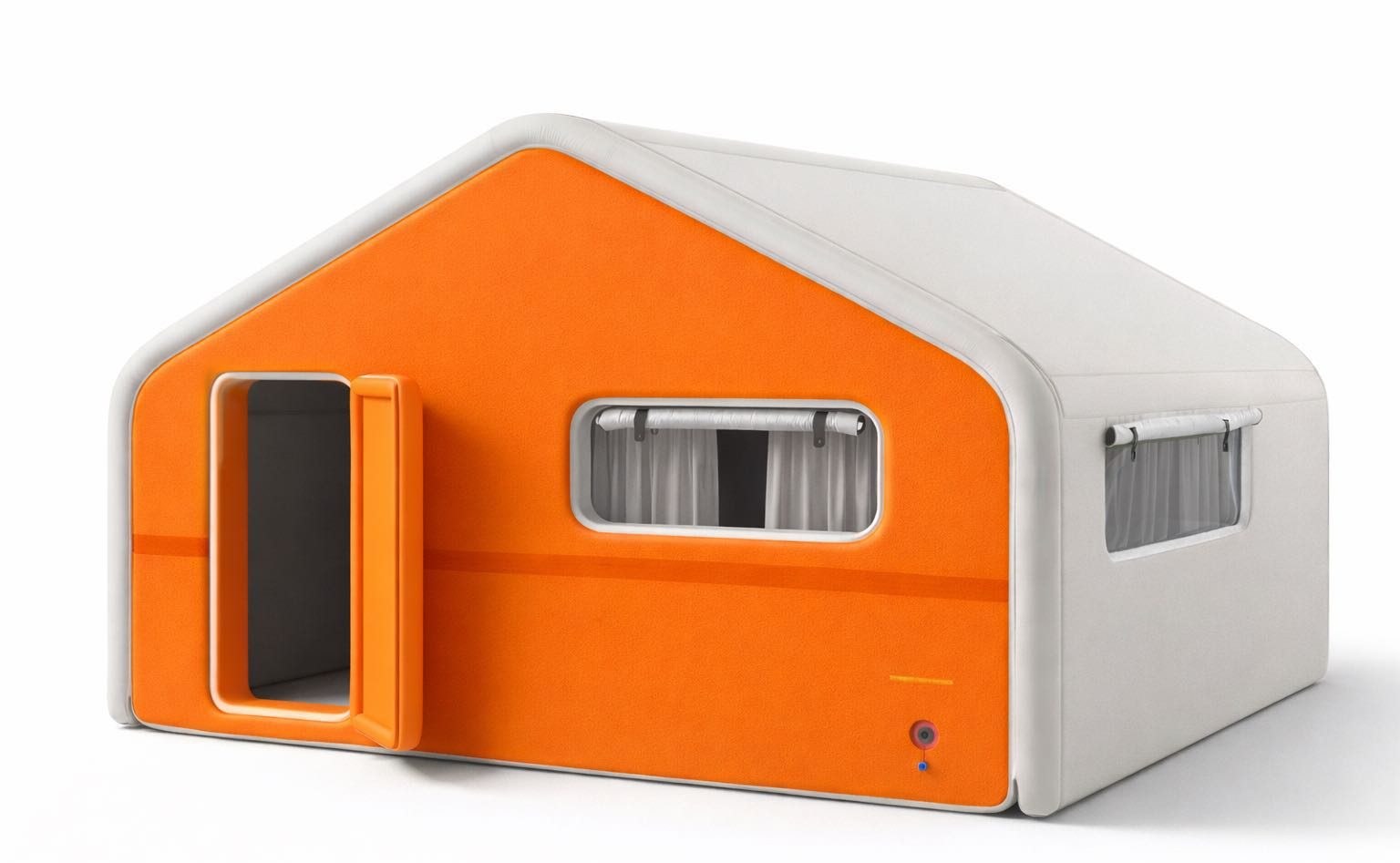
- Can you tell drop-stitch and air-beam apart from a photo?
- Usually. Air-beam shows distinct tube arches and a quilted or ribbed surface. Drop-stitch shows flat wall faces meeting at crisp welded edges.
- Does an air dome need constant power?
- Yes. Air-supported domes are held up by internal pressure from blowers that run continuously, with standby power for blower or mains failure. Air-wall structures run blowers only during erection.
- What happens to an air dome in a power cut?
- It stays up while residual pressure lasts, then deflates. Operators size backup power to cover this, so the risk is managed rather than absent.
Deployment and use
- How long does it take to set up an inflatable shelter?
- Small units are minutes; large-span units take longer and depend on blower capacity and anchoring. Competitors publish 10 to 20 minutes for mid-size military shelters. We will publish our own times once measured, not before.
- How long does it take to set up a field hospital tent?
- For a single module, minutes to inflate plus anchoring time. A multi-module hospital with connecting corridors is a half-day exercise for a trained team.
- How fast can an emergency shelter be deployed?
- Inflation is the fast part. In practice the limiting factors are getting units to site, ground preparation and anchoring — which is why packed volume matters as much as inflation time.
- How fast to deploy a command tent?
- The structure is quick. Making it a working command post — power, cabling, furniture, screens — is the part that sets the real timeline.
- Can inflatable shelters be repaired in the field?
- Yes. Punctures are patched with a repair kit. In chambered construction this is a maintenance task rather than a structural failure.
- How long do inflatable tents last?
- Fabric structures have a shorter service life than metal frames. Published figures elsewhere in the industry range from five to ten years with proper care, but we do not state a figure for our own products without UV ageing data.
- Do inflatable shelters need power to stay up?
- Drop-stitch and air-beam structures do not — blowers run during erection only. Air-supported domes do.
- What shelter works at minus 40?
- Low-temperature performance depends on the coating. TPU stays flexible in cold where PVC stiffens. We do not accept polar projects without low-temperature test data, and we would tell you the same about any supplier who does.
- How to build a camp with no road access?
- Packed volume and erection crew are the two constraints. Inflatable units pack small and need no lifting equipment, which is the whole reason they cost more per square metre than a frame.
Selection — which product, which construction
- Which is better for a field hospital, inflatable or frame?
- Inflatable in most cases, because the deciding factor is how fast the space becomes usable and how much of it fits on the available transport. For a hospital that stays in one place for years, frame or conventional construction is cheaper.
- Which do most military inflatable tents use?
- Air-beam, by volume. Drop-stitch is the newer construction, used where structural redundancy justifies the cost.
- Is an air wall structure more expensive than an air dome?
- Per square metre at large spans, yes, and the gap widens with span. The comparison changes once continuous blower power, backup power and airlocks are priced into the dome.
- Can an air wall structure span the same distances as a dome?
- Span capability depends on verified structural data, which we do not yet have. We are not quoting spans on estimates.
- How big can an inflatable hangar be?
- Large-span capability is exactly the figure that requires working pressure data and a structural calculation. Until we have both we decline to state a maximum.
- What is a mobile command post?
- A deployable working space for command and coordination — tables, power, cabling and screens in a structure that can be erected on an unprepared site and struck again when the operation ends.
- What is a triage tent?
- The space where casualties are sorted by severity before treatment. It sits at the entrance to a field medical facility and its throughput determines the whole hospital's.
- What is a transitional shelter?
- Accommodation between an emergency tent and permanent housing — better insulated and more private than a relief tent, intended for months rather than years.
Flood control and water
- Are flood barriers reusable?
- Both air-filled and water-filled barriers are. They are cleaned, dried and repacked. This is their main advantage over sandbags, which are single use and slow to fill.
- How does a water-filled cofferdam work?
- Water pumped into the tube provides the mass that resists the head of water outside. That is why it needs a water source on site — which is also its limitation.
- How long does it take to deploy a flood barrier?
- Air-filled units are limited by blower capacity, typically minutes for a doorway or ramp. Water-filled units are limited by pump rate and run length, usually longer.
- Can inflatable barriers replace sandbags?
- For defined openings and runs, yes, and deployment is far faster. For irregular gaps and improvised defences sandbags remain more adaptable.
- How much weight can a pontoon bridge hold?
- Load capacity is a structural figure that must be verified, not estimated. We do not publish load ratings without calculation and test data behind them.
- How fast can a floating bridge be assembled?
- Assembly is quick relative to a fixed bridge. Current, water level and anchoring conditions usually determine the real timeline, not the inflation.
- How much load can a floating platform take?
- Same answer as the bridge: verified figure or no figure. Distributed load and point load are different numbers, and suppliers who quote only one are hiding the other.
Rescue and lifting equipment
- How much can an air lifting bag lift?
- The market covers roughly 1.5 to 86 tonnes per bag depending on size and pressure class. Capacity falls as lift height increases, so the rated figure is not the working figure at full extension.
- What pressure do lifting bags use?
- High-pressure bags typically run at around 8 bar; low-pressure bags at under 1 bar with far greater lift height. They are different tools for different jobs.
- How high can you jump into a rescue cushion?
- Rescue cushions are rated to a maximum jump height by standard, commonly EN 1869 in Europe. We do not supply life-safety rescue equipment without that certification and would advise against any supplier who does.
- How fast does a rescue cushion inflate?
- Seconds to tens of seconds depending on size and blower. For life-safety equipment the certified figure in the test report is the one that matters, not a marketing number.
- Can a stretcher float?
- Inflatable stretchers can be built with enough buoyancy to float a casualty, which is why they are used in water rescue. Buoyancy figures must be measured, not assumed.
- How much weight can an inflatable stretcher take?
- A verified figure, or none. This is a life-safety product and we will not publish an estimate.
- How do inflatable fenders work?
- The fender compresses on impact and the enclosed air absorbs the energy, spreading the load over a larger contact area than a rigid bumper. Sizing depends on vessel displacement and berthing speed.
Materials and fabric supply
- Is TPU always better than PVC?
- No. TPU is better in cold, better under UV and lighter for equal strength. It costs more, has a narrower colour range and different welding parameters. For temperate seasonal use PVC is usually the correct commercial choice.
- What is the price difference between PVC and TPU?
- The commonly quoted range is 30 to 60 percent, but the real figure moves with thickness, width, order size and resin prices. We do not publish a number we have not confirmed with the mill.
- What base fabric is used in drop-stitch?
- 1000D × 1000D polyester is the industry reference. Denier, thread density and coating thickness are three separate specifications, and a single gsm figure conceals all three — ask for them individually.
- What is the minimum order for drop-stitch fabric?
- Industry MOQ sits around 50 m², with some mills negotiating to 30 m². Our own terms are still being confirmed with the manufacturing partner.
- Can you supply fabric rather than finished products?
- That is under discussion with our manufacturing partner. We will say yes or no once we have a firm answer rather than take an order we cannot fill.
- What thickness should a sleeping pad be?
- Consumer sleeping pads commonly run 5 to 10 cm. Thickness trades comfort against packed size, and insulation value depends on construction as much as depth.
Certification and compliance
- Do you have fire certification?
- Fire test reports are being obtained. EN 13501, NFPA 701 and GB are different standards and are not interchangeable, so the correct one depends on your market. We will send report numbers when we have them and will not claim a rating we cannot evidence.
- Are your products CE marked?
- Certification status is being verified with our manufacturing partner. We publish report numbers, not claims.
- Can you meet UNHCR or humanitarian procurement standards?
- Those programmes require documented test reports as a condition of entry to the supplier list. That documentation is what we are assembling now — it is a prerequisite, not a bonus.
- Are fuel bladders safe?
- Properly specified and correctly installed, yes — they are standard military and industrial equipment. Fuel storage carries fire and static requirements set by local regulation, and material compatibility must be evidenced by test report.
- How long can water be stored in a bladder?
- Potable water storage requires food-grade liner material with the appropriate certification. Storage duration depends on that material, temperature and treatment — an industrial-grade bladder must never be used for drinking water.
- What pressure can a pipe plug hold?
- Pipe plugs are rated by diameter and back pressure, and the rating must come from the manufacturer's test data. Plug failure during pressure testing injures people, so this is a category with no tolerance for estimates.
Commercial terms
- What should I send you for a useful answer?
- Application, operating environment, quantity and timing. Those four let us tell you what is documented today and what would need testing.
- How fast can you quote?
- We are not quoting yet. Certification and measured performance data are still being verified with the manufacturing partner, and we would rather say that than publish a number we cannot stand behind.
- What is your minimum order quantity?
- Being confirmed with the manufacturing partner. We will publish it once it is firm.
- Do you accept OEM and custom builds?
- Custom sizing and configuration is the normal case in this category rather than the exception. Send the specification and we will tell you point by point what we can build and what we would decline.
- How much does a glamping pod cost?
- Comparable units in the international market sit broadly in the fifteen to thirty thousand US dollar band including fit-out. Our own pricing is not published yet.
- How much does a bounce house cost?
- Amusement inflatables use lighter fabric and a different manufacturing process from our product line. We are not the right supplier for that category and would point you elsewhere.
- How many dunnage bags fit in a container?
- That depends on cargo geometry and void size. This category is dominated by low-cost single-use paper-plastic products, and our heavy reusable construction is not cost-competitive for ordinary freight.
Not answered here?
Send the specific question with your project background to the sales address, or use the RFQ form. Technical questions are answered by engineering staff directly, not by a support script.
Page updated 2026-10-10