A 150-bed hospital, deployed in hours
Rapid-deployment inflatable hospital systems for disaster relief, outbreak response and humanitarian missions. Standardized, modular, self-sufficient — from empty ground to a fully equipped hospital in a single day.
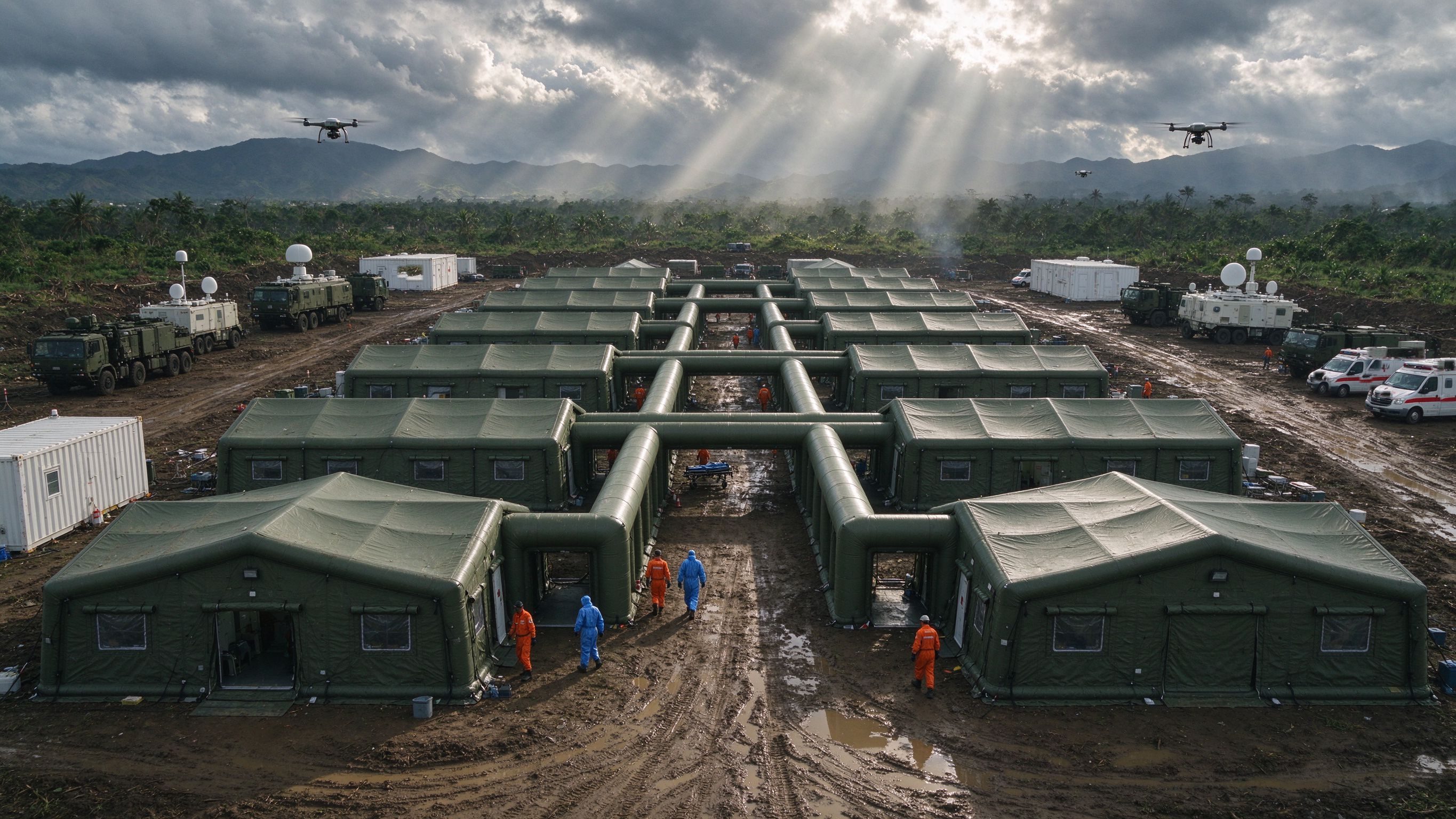
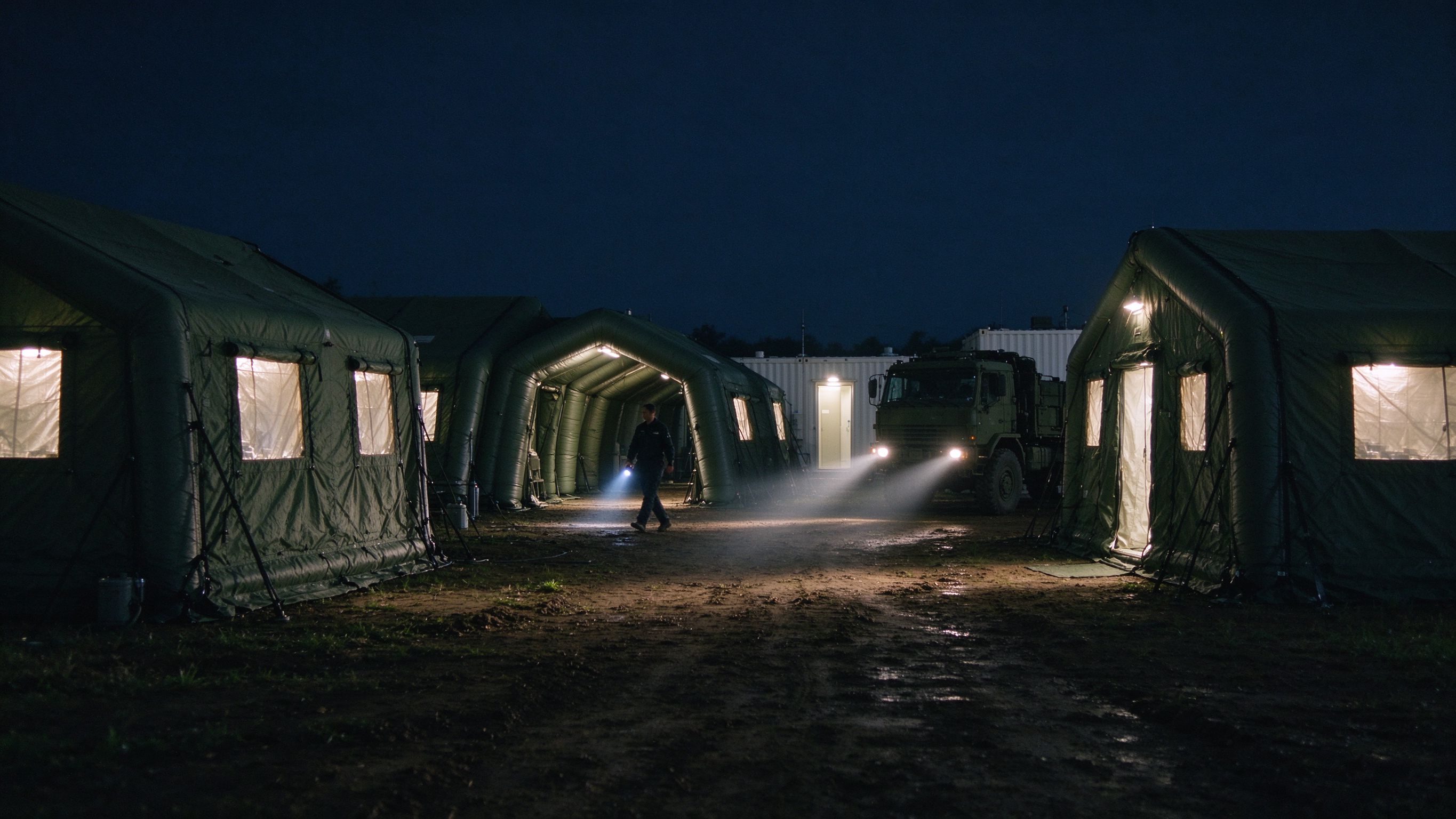
A full hospital camp: membrane wards linked by sealed inflatable passages
Conventional container hospitals take days to erect, demand prepared foundations and cost heavily to relocate. Conventional tent hospitals go up faster — but offer poor stability, no climate control, and cannot protect precision medical equipment. Emergency response needs an intermediate answer: hour-level deployment with a real clinical environment.
The system, as modules
Five module families snap together into one hospital. Each ships as standard cargo; each is operational minutes after arrival.
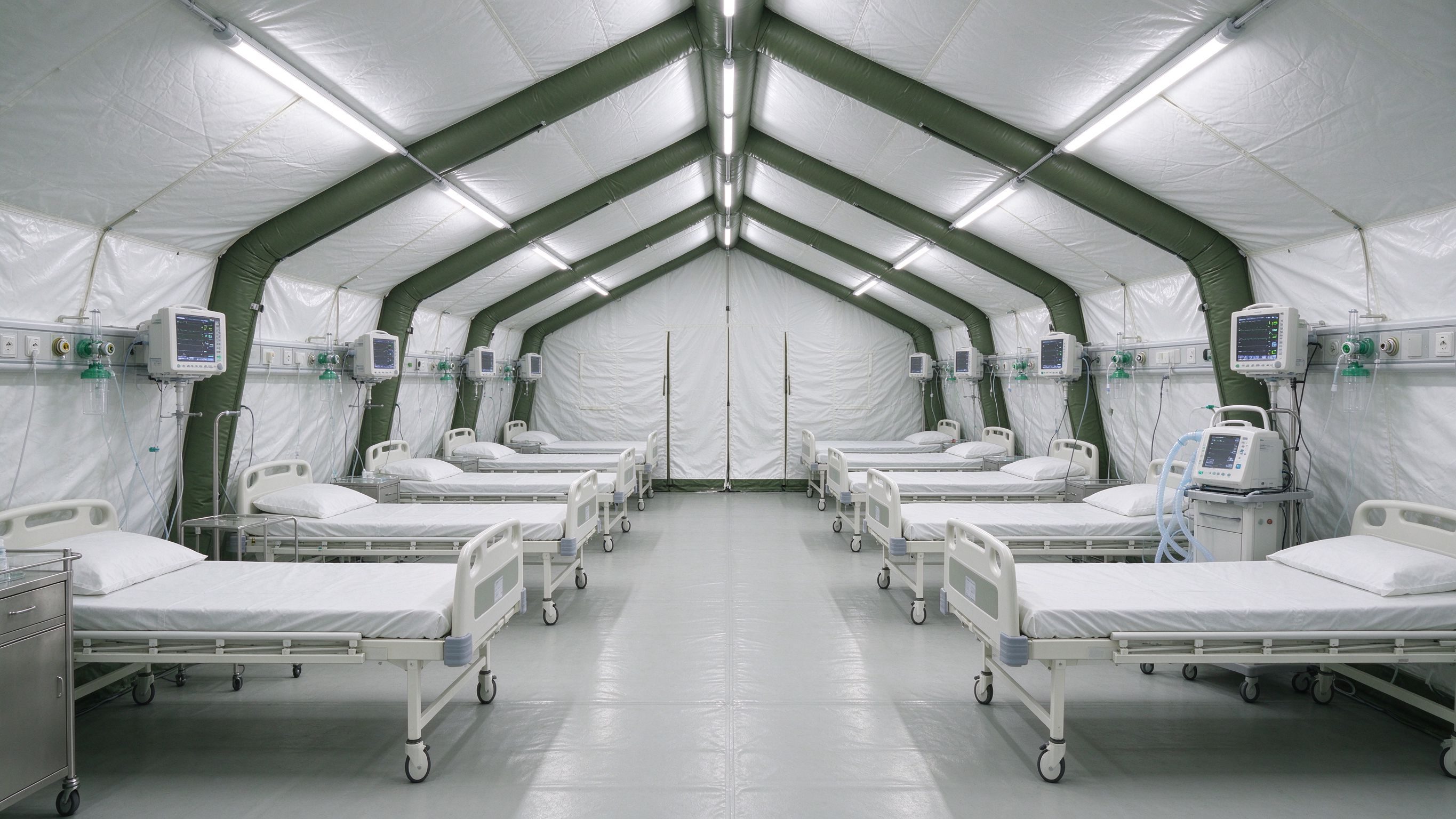
- Inflatable membrane wards — High-stability drop-stitch membrane structures with 15–30 cm walls, formed in 15–20 minutes. Column-free interior, rated down to −40 °C.
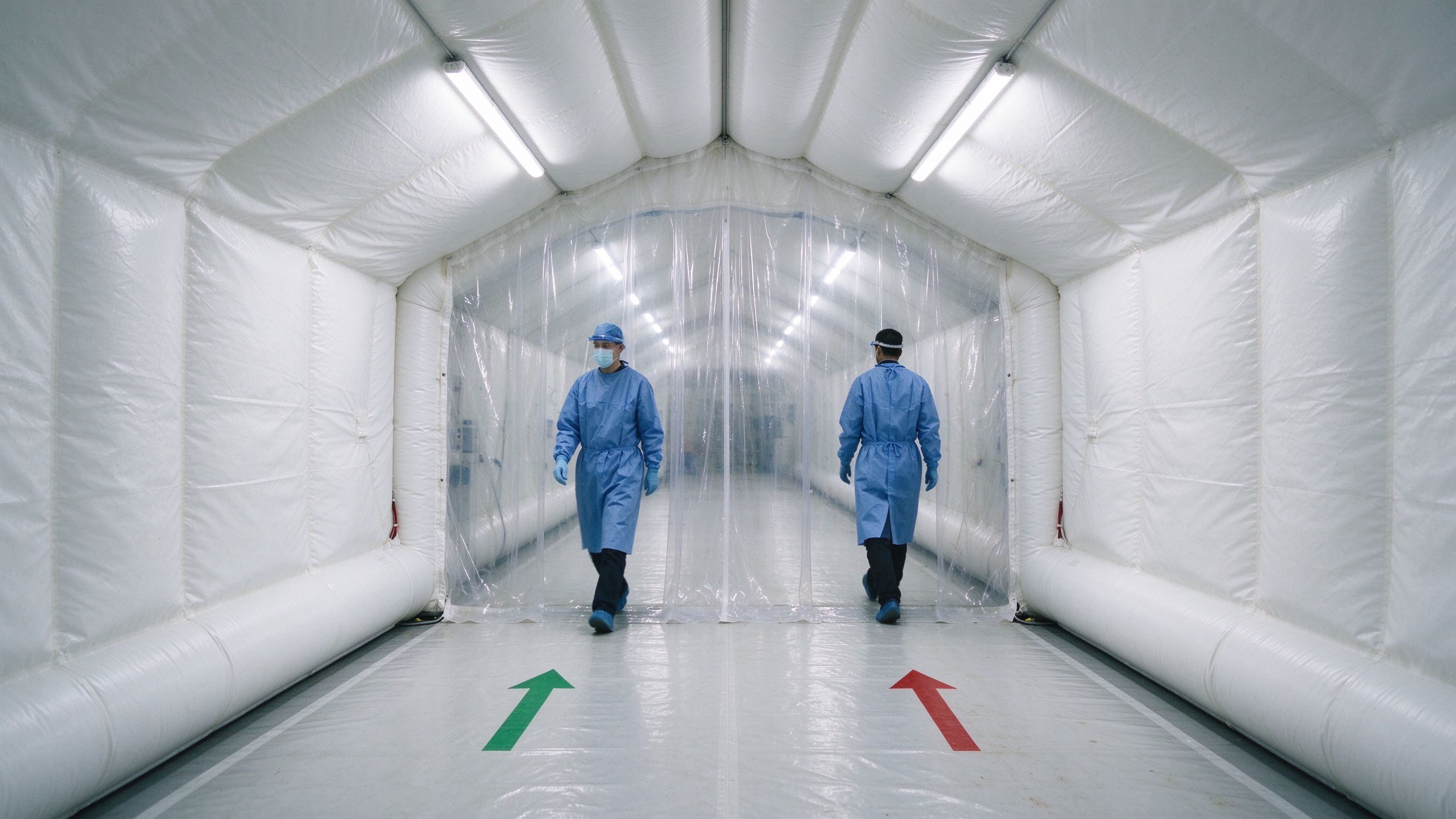
- Connector passages — The vascular system of the hospital: sealed inflatable corridors that link every unit and separate staff and patient flows.
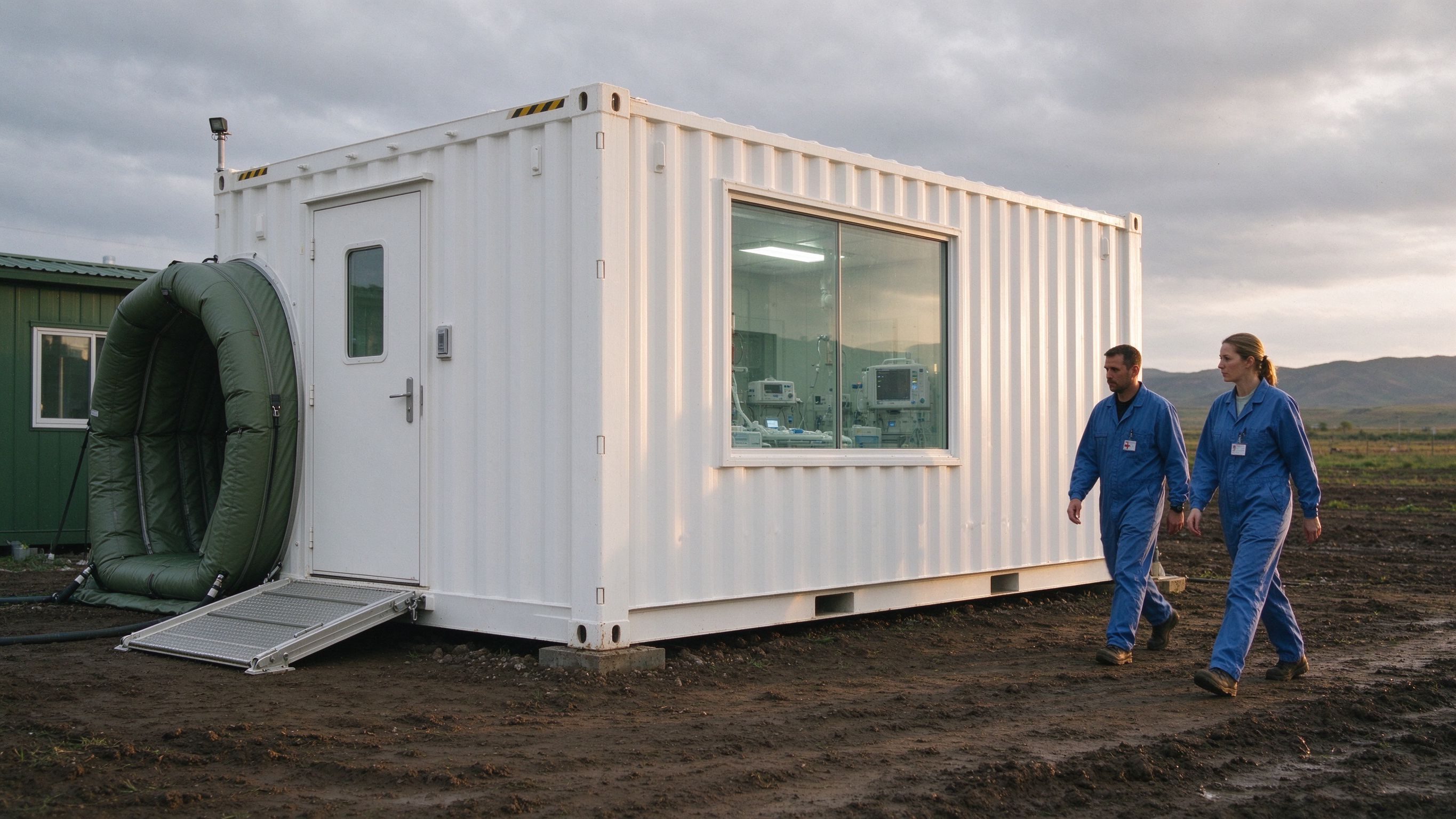
- Containerized clinical units — Heavy-duty functional shelters carrying the operating theatre, CT/DR imaging and the PCR laboratory.
- Life-support systems — Power, oxygen, water and communications integrated for fully independent operation.
- Medical equipment & intelligent management — Monitoring, ventilation and imaging, plus wearable patient monitoring and digital triage.
From trucks to triage in five steps
Site survey → rapid erection → utility connection → equipment commissioning → handover. No heavy machinery, no paved foundation, no complex approvals. A 50-bed hospital stands in 6–8 hours; a 150-bed hospital in 12–15 hours. Packed volume is under 10 % of deployed size — one hospital, a few standard truckloads.
One ward, one blower: from folded fabric to formed structure in minutes
Three standard configurations
Every configuration is a starting point, not a limit — modules add or remove on demand.
| Scale | Composition | Deployment | Benchmark |
|---|---|---|---|
| 50 beds | 12 functional tents + 4 clinical shelters | 6–8 h | WHO EMT Type 3 |
| 100 beds | 22 functional tents + 6 clinical shelters | 8–10 h | UN Level 3 field hospital |
| 150 beds | 34 functional tents + 10 clinical shelters | 12–15 h | Major outbreak response centre |
Composition and deployment times are reference values for a prepared crew; final layout follows the mission profile.
Ready for filovirus outbreaks
An isolation-enhanced configuration adds screening and triage, suspected and confirmed wards with lined isolation, a negative-pressure ICU with HEPA exhaust, separated donning and doffing areas, decontamination passages, on-site PCR testing and a positive-pressure rest zone for staff. The layout follows the three-zones-two-passages principle — clean, buffer and contaminated zones with fully separated staff and patient routes. The layout itself is the first line of infection control.
Independent of city utilities
Power
Dual mains plus backup plus UPS redundancy; ≥72 h off-grid operation.
Oxygen
On-site PSA oxygen generation, ≥99.5 % purity — no dependence on cylinder logistics.
Water
Two-stage reverse osmosis turns river or well water into medical-grade water at ≥500 L/h.
The hospital keeps running when the surrounding infrastructure does not.
Digitized from arrival
Wearable sensors monitor ECG, blood pressure, SpO₂, temperature and respiration without disturbing the patient — one screen for six patients, wearable in under ten seconds. Digital triage tags casualties by priority; a command dashboard tracks patient flow and resource consumption in real time, with data feeding remote specialists over 5G or satellite.
Why inflatable membrane structures
- Deployment speed — Hours, not days.
- Space — Seamless modular connection, no column grids, unlimited expansion.
- Environment — Constant temperature and humidity — a clinical-grade interior.
- Logistics — Packed volume under 10 %, standard truck or container shipping.
- Site adaptability — Works on unprepared ground; no foundation works.
- Interconnection — Sealed inflatable passages link every unit; staff and patients on separate routes.
From tropical heat to arctic cold
The membrane system is engineered for −40 °C cold regions and for hot, humid tropics alike — the same camp that shelters avalanche rescue in the mountains runs an isolation ward in the equatorial zone.
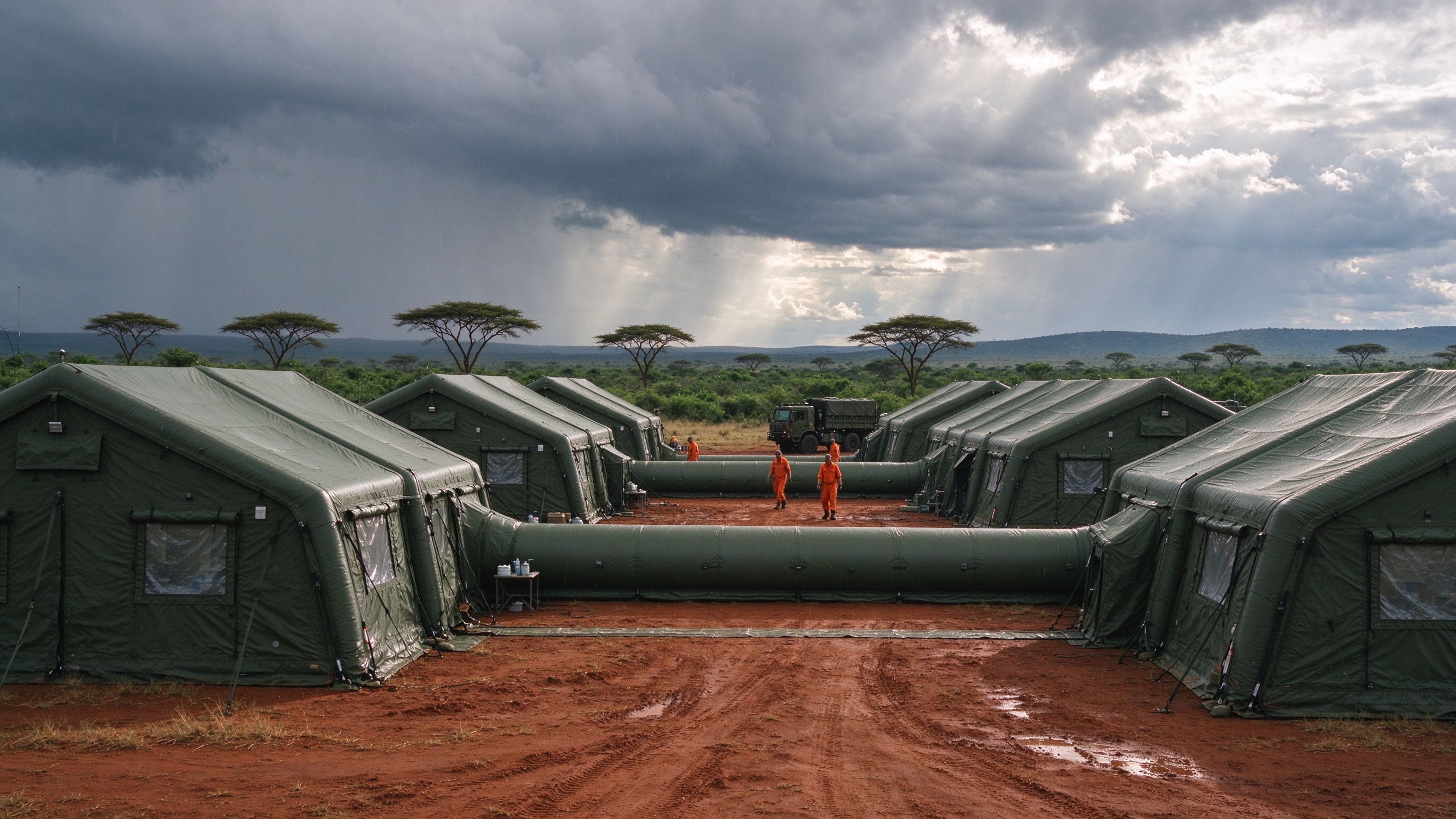
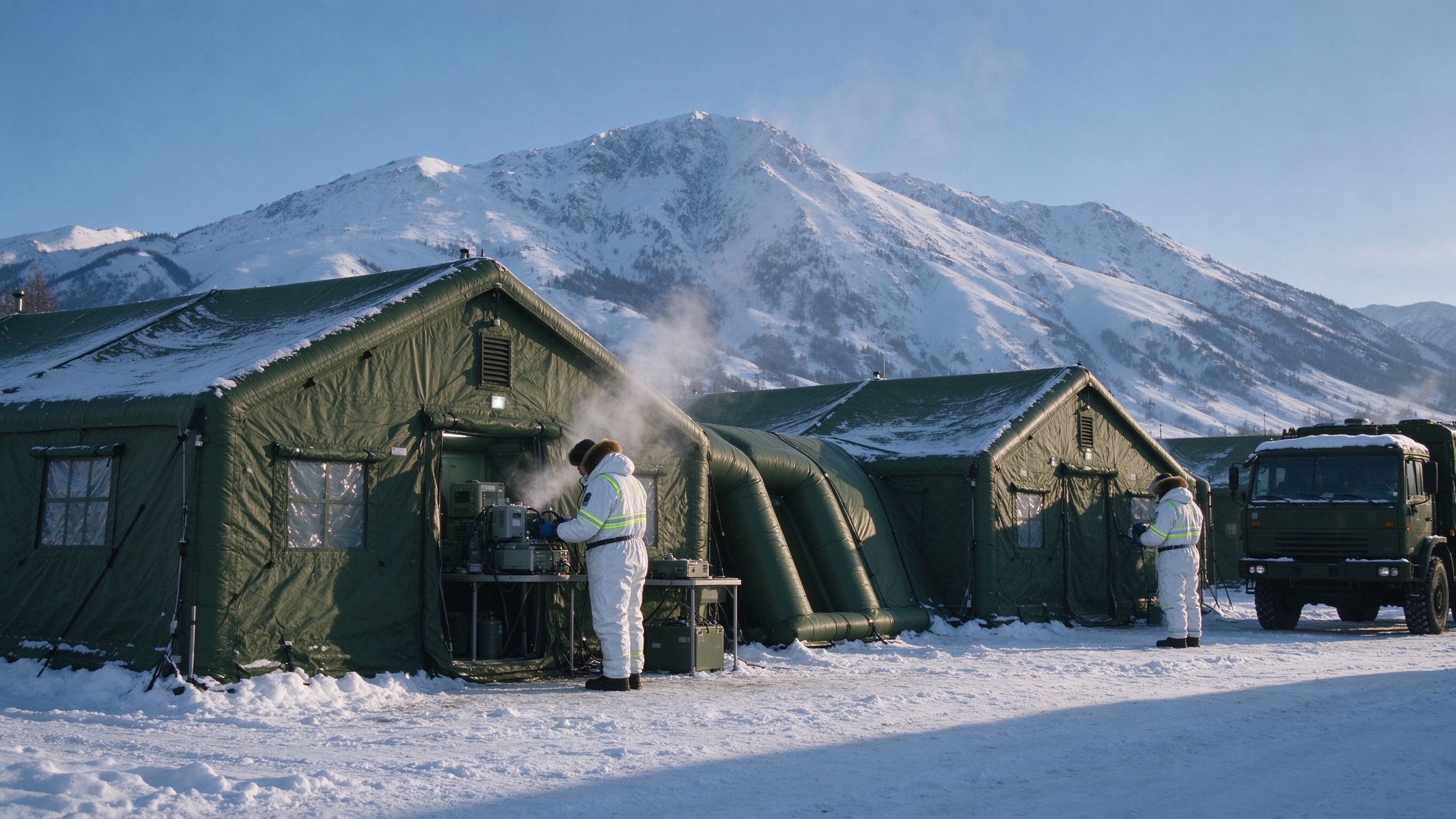
Inside the system
Ways to work with us
Product sales · Rental programs · Turnkey project delivery · Joint development for specific scenarios.
Request the full solution overview — module lists, layout examples and deployment plans are available on request; project documentation can be shared under NDA.
Страница обновлена 2026-10-10
Частые вопросы
- How fast can the hospital be deployed?
- A 50-bed configuration stands in 6–8 hours and a 150-bed hospital in 12–15 hours, including utility connection and equipment commissioning. Packed volume is under 10 % of the deployed size, so the entire hospital moves on a few standard truckloads.
- Does the hospital need existing infrastructure?
- No. Power comes from dual mains with backup and UPS (≥72 h off-grid), oxygen is generated on site by PSA units at ≥99.5 % purity, and a two-stage reverse-osmosis unit turns river or well water into medical-grade water at ≥500 L/h.
- Can it handle highly infectious diseases such as Ebola?
- Yes. The isolation-enhanced configuration applies the three-zones-two-passages principle: clean, buffer and contaminated zones with fully separated staff and patient routes, a negative-pressure ICU with HEPA exhaust, lined isolation wards, decontamination passages and on-site PCR testing.
- What climates can it operate in?
- The membrane structures are rated down to −40 °C and are deployed routinely in hot, humid tropical regions — the fabric, HVAC and anchoring are specified per mission profile.
- Can the configuration be customized?
- Every configuration is a starting point. Wards, clinical shelters, laboratory and decontamination modules add or remove on demand, and layouts are drawn around the mission profile — from earthquake response to outbreak control.
- How is the hospital shipped?
- All modules pack to under 10 % of deployed volume and ship as standard cargo — flatbed trucks or standard containers, no special handling, no heavy machinery at the site.